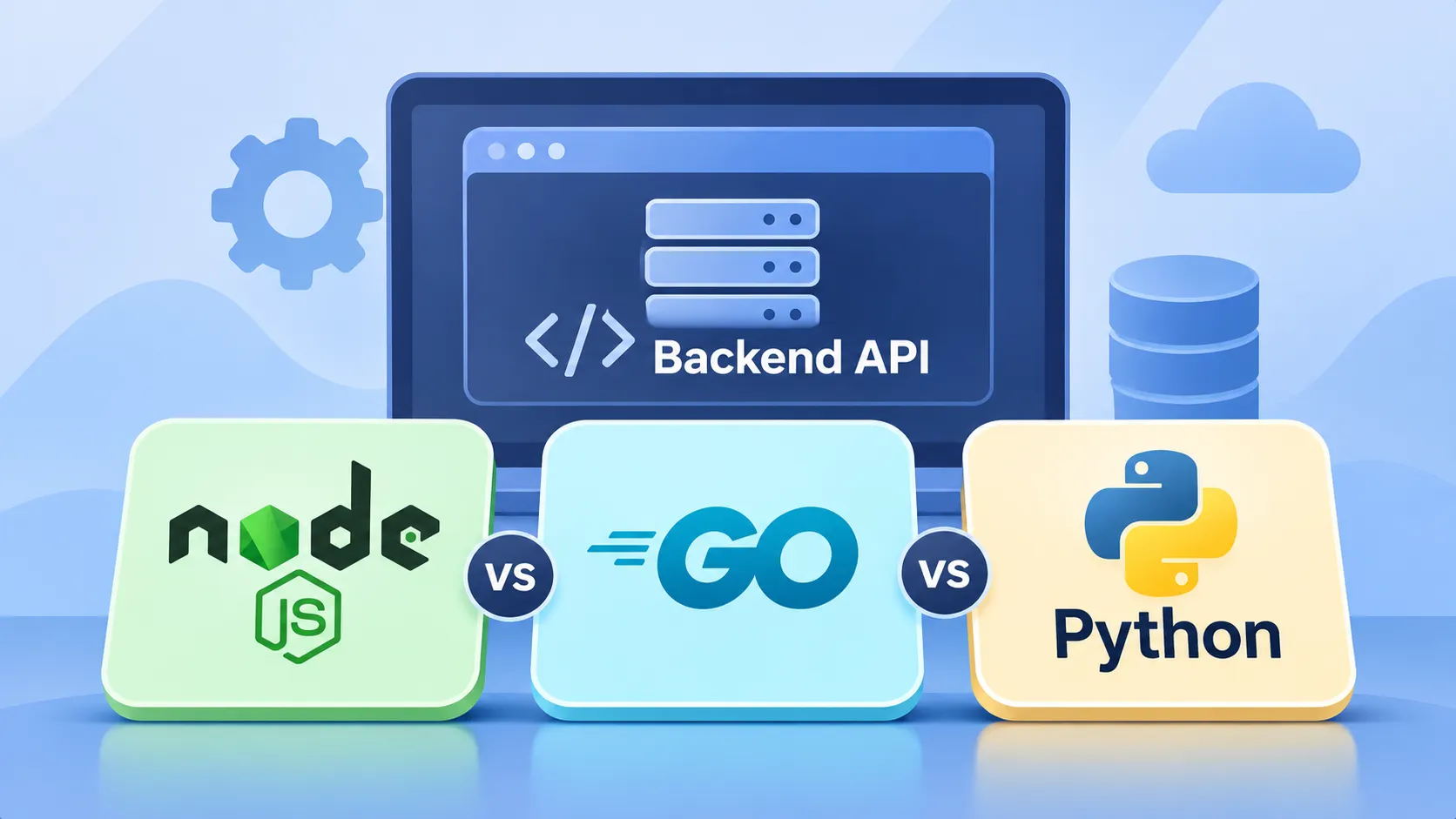
Most backend APIs spend their time waiting on databases, caches, queues and other APIs. For that kind of work, all three runtimes are capable. The choice usually comes down to what else the service must do and who will maintain it.
This comparison judges Node.js, Go and Python on six stated criteria and ends with a pick for specific situations. Python facts are pinned to Python 3.14 and Python 3.15. Node.js and Go version numbers are not pinned here: check the Node.js release page and the Go download page for the supported versions before you commit.
Treat every performance statement as a starting hypothesis. Load-test your own endpoints before you decide.
Quick answer
Use this as a first filter, then read the criteria below.
- Python when the API sits close to data, machine learning or LLM work.
- Node.js with TypeScript when the API is I/O-heavy, real-time, or shares a language and types with a JavaScript frontend.
- Go when you want a small, efficient, standalone service and a codebase that reads the same across the team.
For a typical CRUD API, your database queries, external calls and network latency will set the pace, not the language. Do not pick on raw benchmark numbers alone.
The criteria used to judge them
Each runtime is scored on the same six questions.
- I/O concurrency: how it handles many connections that mostly wait.
- CPU-bound work: what happens when a request computes instead of waits.
- Ecosystem fit: how close the libraries are to the work around your API.
- Team and hiring: who can write and maintain it.
- Code consistency: how easy it is to keep a codebase uniform.
- Release and upgrade cadence: how often you must move versions.
| Criterion | Node.js | Go | Python |
|---|---|---|---|
| I/O concurrency | Non-blocking I/O by default | Check Go's concurrency docs and test | asyncio plus an ASGI framework, if every library is async |
| CPU-bound work | One main thread; use worker threads | Test with your workload | Multiple processes; free-threaded build supported in 3.14 |
| Ecosystem | Full-stack TypeScript | Standard library as worked examples | Data, ML and LLM tooling first |
| Team | Full-stack JS engineers | Go specialists | Web plus data engineers |
| Consistency | Team conventions | gofmt standard style |
Team conventions and type checking |
| Cadence | LTS lines; check release page | Check release page | New minor each October, five years of support |
The Go column is deliberately thin where the official Effective Go page makes no claim. Fill those cells with your own measurements.
I/O concurrency: the common case
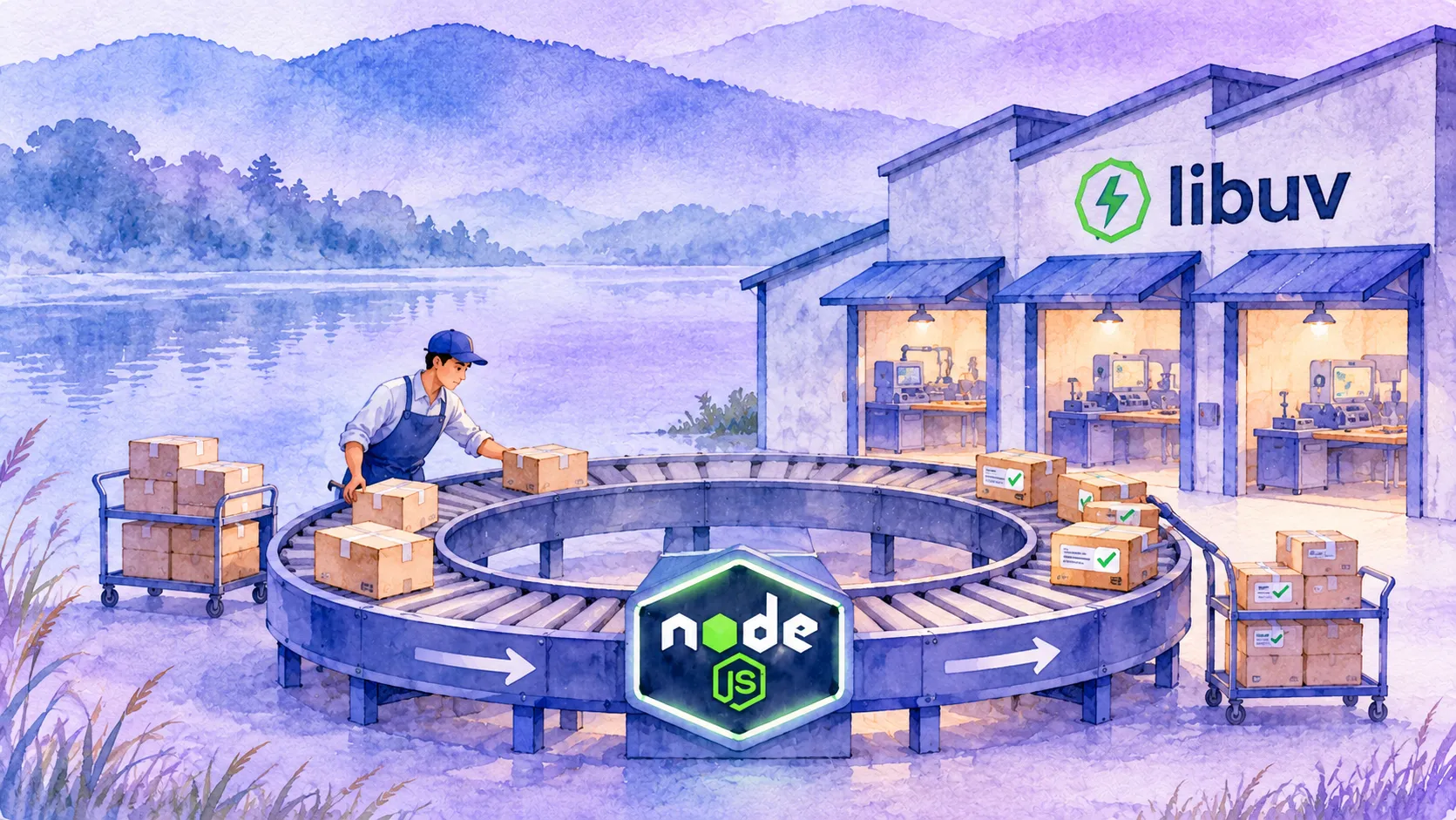
Node.js was designed around non-blocking I/O. Every I/O call is non-blocking by default, so one process serves many concurrent connections with low overhead. The V8 JIT keeps JavaScript execution fast.
Python can follow the same pattern. The official asyncio page describes it as a library for concurrent code using async/await, and as a foundation for high-performance network and web servers. It calls asyncio often a perfect fit for IO-bound and high-level structured network code.
There is one trap. Python only matches Node.js here if every library in the request path is async. One synchronous database driver or HTTP call inside an async handler stalls the event loop for every other request.
Go describes itself as a language focused on simplicity, reliability and efficiency, designed to make it easy to build software at scale. That is a design goal, not a throughput figure. Read the Go concurrency material and run a load test on your own endpoints.
Verdict: Node.js and Go are the lowest-risk defaults for I/O-heavy APIs. Python is equally viable if you keep the whole request path async.
import asyncio

async def main():
    result = await asyncio.sleep(1, result='hello')
    print(result)

asyncio.run(main())
CPU-bound work in the request path
No runtime is ideal for heavy computation inside a request handler.
- Node.js runs JavaScript on one main thread. CPU-heavy code blocks every other request unless you move it to worker threads.
- Python has historically used a global interpreter lock in standard CPython, so CPU parallelism means multiple processes. Python 3.14 made the free-threaded build officially supported. That opens the door to true multi-threaded Python, but library support is still catching up.
- Go is not covered by a CPU comparison in the official Effective Go page. Benchmark your own computation before you assume an advantage.
In practice, Python's numeric speed comes from native libraries such as NumPy, PyTorch and Polars. For pure-language CPU work, V8 is usually faster than CPython.
Verdict: if the work is heavy, move it out of the request path into a queue, a worker or a separate service. That advice holds for all three.
Ecosystem fit: what else does the service do?
This is often the deciding factor.
Python leads when the service touches data, ML or LLM work. NumPy, PyTorch, Polars, notebooks, evaluation harnesses, embeddings pipelines and fine-tuning tools live there first. Major LLM providers offer official SDKs for both Python and Node.js, so calling a hosted model is easy from either. The gap is in everything around the call.
Node.js leads when the frontend is JavaScript or TypeScript. You get one language and one set of shared type definitions across the stack, less context switching and simpler onboarding.
Go has no pull from a frontend or a data stack. Its case rests on language design. The official Effective Go page notes the Go package sources are meant to serve as both core library and examples, with many packages carrying runnable examples.
A common enterprise pattern combines runtimes: a TypeScript API layer serves the web app and calls Python services for AI work. Keep model-loading services separate from lightweight API services, because Python services that load large ML libraries can have heavy cold starts and memory footprints.
Team, hiring and code consistency
Pick the language your team already writes well. A team in a familiar language ships faster, and those savings compound.
Node.js hiring favors full-stack TypeScript engineers who can work across React and the API. Senior signals include event-loop awareness, stream handling, memory leak debugging and TypeScript type design.
Python hiring splits into web backend engineers (Django, FastAPI) and data or ML engineers. For AI backends you often want someone with both. Senior signals include async correctness, packaging discipline, type-checked code and profiling.
Go consistency is the strongest of the three by design. The gofmt program reads a Go program and emits it in a standard style of indentation and vertical alignment. Effective Go says to let the machine handle formatting and not to work around it. Visibility is set by whether a name starts with an upper-case letter, so naming carries meaning. Effective Go also warns that a straightforward translation of a C++ or Java program into Go is unlikely to be satisfactory: the team needs to learn Go idioms.
Team shape is also a cost lever. One TypeScript team owning frontend and backend lowers coordination cost. A Python backend saves a second language when your data and AI work already lives in Python.
package main

type T struct {
    name  string // name of the object
    value int    // its value
}

func main() {
    _ = T{name: "example", value: 1}
}
gofmt main.go
Release cadence and upgrades
Plan for upgrades from day one.
- Python releases a new minor version every October, each supported for five years. This guide pins Python 3.14 and Python 3.15. Python 3.14 began shipping an experimental JIT in binary releases, so yearly upgrades keep you on current performance work.
- Node.js is changing its release cadence. Production apps should run Active or Maintenance LTS versions. Check the Node.js release page for the current schedule.
- Go: check the official Go release information for the supported versions.
A service pinned to an unsupported runtime is a security and hiring problem later. Schedule a yearly upgrade review whichever you choose.
Pick by situation
| Your situation | Pick | Why |
|---|---|---|
| API serves a React or Vue app, team is JavaScript-first | Node.js with TypeScript | Shared language and types, non-blocking I/O |
| Live notifications, chat, collaborative editing | Node.js | Event-driven design fits many open connections |
| API wraps ML models, data pipelines or LLM tooling | Python | Libraries and data tooling live there first |
| Rapid prototype of a database-backed API | Python with FastAPI or Django | Fast to build; async needs care |
| Small standalone service, uniform style across many contributors | Go | Simplicity focus and gofmt consistency |
| Mixed product with web app and AI features | TypeScript API plus Python services | Each runtime does what it does best |
If none of these rows fits, choose the language your team can maintain, then load-test it.
What we compared
- I/O concurrency: how well one process handles many connections that mostly wait.
- CPU-bound work: what happens when a request computes instead of waits.
- Ecosystem fit: how close the libraries are to the data, ML or frontend work around the API.
- Team and hiring: who can write and maintain the codebase.
- Code consistency: how easily the team keeps a uniform style.
- Release cadence: how often you must upgrade and how long versions are supported.
Recommendation
Choose Node.js with TypeScript when the API is I/O-heavy or real-time, or shares types with a JavaScript frontend. Choose Python when the API sits close to data, ML or LLM work, and keep the whole request path async. Choose Go for a small, standalone service where simplicity and a uniform style across contributors matter. If the product has both a web app and AI features, use a TypeScript API layer that calls Python services. Whatever you pick, load-test your own endpoints and move heavy CPU work out of the request path.
Caveats
- Throughput comparisons depend on workload. For typical CRUD APIs, database queries and network latency dominate, so language speed rarely decides.
- The Go column rests on the design goals in Effective Go, not on measured numbers. Benchmark Go against your own workload.
- Free-threaded Python is officially supported in 3.14, but library support is still catching up.
- Python async only helps if every library in the request path is async.
- Node.js release cadence is changing. Check the Node.js release page for the supported versions.
- Hiring conditions vary by region and over time. Check your local market.
Frequently asked questions
Is Node.js faster than Python for an API?
For I/O-bound APIs, Node.js is non-blocking by default, and Python can match the pattern with asyncio and an ASGI framework if every library is async. For pure-language CPU work, V8 is usually faster than CPython. For typical CRUD workloads, neither is the bottleneck.
When should I choose Python over Node.js?
Choose Python when the backend sits close to data, machine learning or LLM work, because the libraries, data tooling and evaluation harnesses live there first.
What is the main reason to choose Go?
Go focuses on simplicity, reliability and efficiency for building software at scale, and gofmt gives every codebase one standard style. Benchmark it against your own workload.
Does free-threaded Python remove the need for multiple processes?
Not yet in practice. Python 3.14 made the free-threaded build officially supported, but library support is still catching up.
Can I use more than one runtime?
Yes. A common pattern is a TypeScript API layer for the web app that calls Python services for AI work.
Which Node.js versions should I run in production?
Run Active or Maintenance LTS versions. Check the Node.js release page for the current schedule.
References
From Grokem: https://www.grokem.com/programming/web-development/backend/nodejs-vs-go-vs-python-for-a-backend-api-which-to-pick-by-team-and-workload